Newar craft and custom · Patan
Bahals, bahis and the courtyards behind the streets
Duck through a low passage off a Patan lane and the city opens into courtyards: Buddhist monastery squares, chaityas, sunken water spouts and the daily life of the neighbourhoods that keep them.
- Era
- Many eras
- From Thamel
- A short taxi ride south to Patan
- Bring
- Socks, small change for offerings, a quiet manner
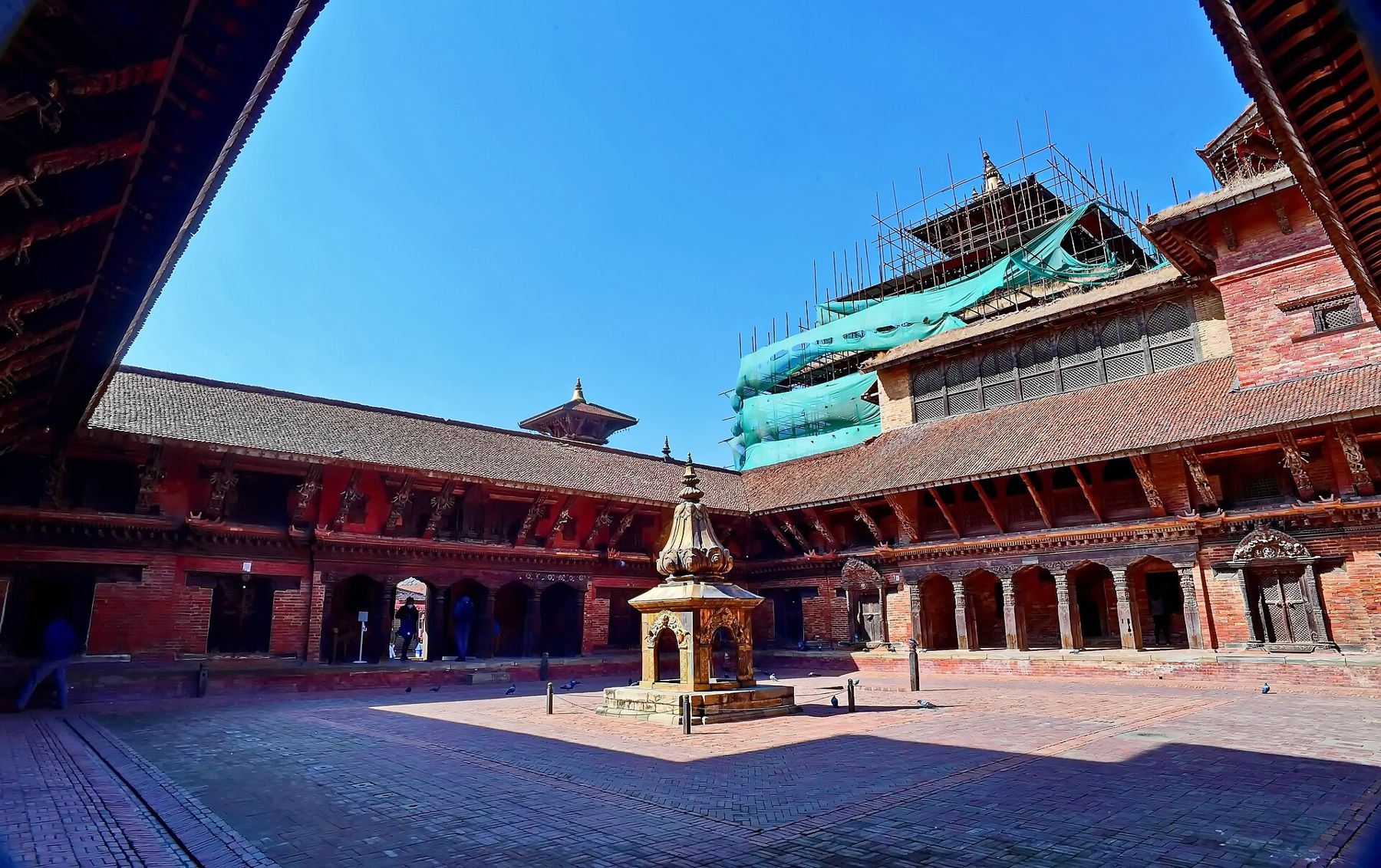
The Newar cities are built inward. From the street, Patan, Yala in Newar, looks like a continuous wall of brick houses and shopfronts. But every few doors a dark passage, often low enough to make you bow, leads through the block into a courtyard. Some are small and domestic. Others are wide squares with a shrine at one end, a stupa in the middle and a stone water spout sunk below the paving.
These courtyards are the old units of city life. Learning to read them, and to enter them with good manners, is one of the real pleasures of the valley.
What a bahal is
A bahal is a Buddhist monastery courtyard in the Newar tradition. The word comes from the Sanskrit vihara. In its classic form it is a square courtyard enclosed by two- or three-storey buildings, with a shrine to the main deity facing the entrance passage. A carved and painted torana, a semicircular panel over the shrine door, shows the deity and its attendants.
Unlike monasteries in many Buddhist countries, the Newar bahal is not home to celibate monks. It belongs to a community of families, mainly from the Shakya and Vajracharya groups, who inherit membership, take turns caring for the shrine and perform its rites. Boys of these families pass through a short ordination as monks and then return to household life. A bahal is a monastery, a neighbourhood and a family institution at once.
A bahi is a related kind of monastery. Bahis tend to be plainer, with a more open ground floor and fewer storeys, and some are thought to preserve an older monastic pattern. In practice you will meet both on a walk, and the difference matters more to scholars than to visitors.
Where to start in Patan
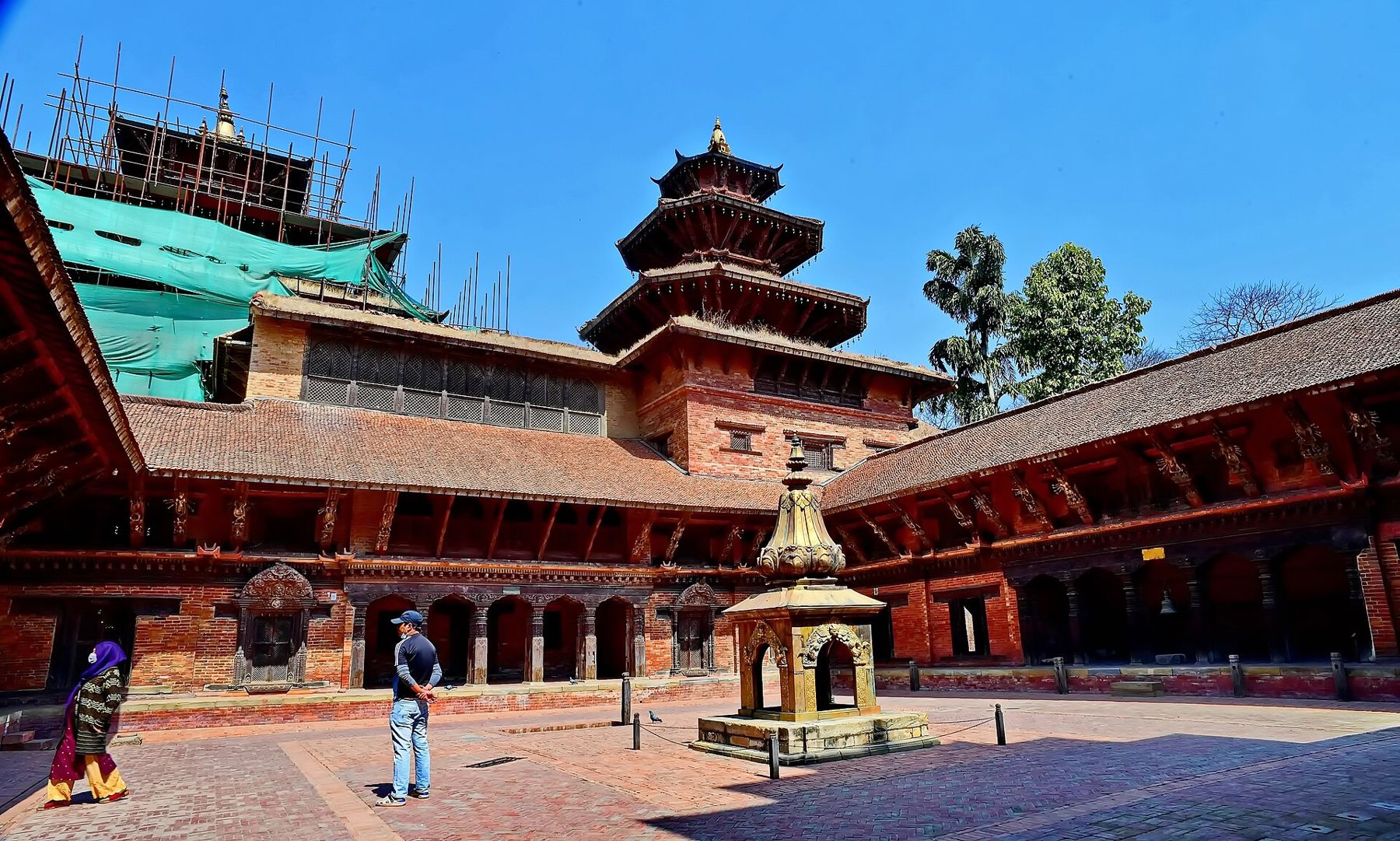
Patan has more of these courtyards than any other city in the valley. The best known is Kwa Bahal, the Golden Temple, a short walk north of Durbar Square, covered in the guide to Patan, the city of fine arts. Its gilded facade can set too high a bar; most bahals are quieter, with worn brick, a few bells and a single lamp.
South-east of the square, a lane leads to Uku Bahal, with its metal-roofed shrine and courtyard full of animal figures, and nearby to Mahabouddha, a tall terracotta temple covered in small images of the Buddha and squeezed into a courtyard so tight you have to tilt your head right back to see it. West of the square, Ta Bahal is the home of the red Machhindranath, the deity carried through Patan each year in a towering chariot.
There is no need for a fixed route. Walk the lanes between these places, and step into any open passage that leads to a shrine. Many of the finest courtyards have no name on any map.
Also in the valleyLost-wax casting and woodcarving in PatanChaityas, shrines and courtyard life
The objects in a courtyard repay a slow look. The small stone stupas called chaityas stand on the paving, some with four Buddha figures facing the four directions, some centuries old and smoothed by hands. There may be a dharmadhatu mandala on a stone plinth, a pillar topped with a lotus or a vajra, and rows of prayer wheels or bells along the walls.
Around these, ordinary life goes on. Grain and chillies dry on mats. Children play. Women carry water and offerings, and older men sit on the platforms by the passage. A courtyard can be busy with a family rite one hour and empty the next.
The hiti, the city's water
Among the most striking features of the old cities are the sunken stone water spouts called hiti, or dhunge dhara in Nepali. A flight of steps leads down to a paved basin well below street level, where water flows from carved stone spouts. The spouts usually take the form of a makara, a mythical water creature, with water pouring from its mouth.
The spouts are fed by old channels and ponds that brought water from higher ground, a system built up over many centuries. Manga Hiti, on the edge of Patan's Durbar Square, is among the oldest still in use, with carved spouts that go back to the Licchavi period. Many hiti have dried up as the city grew and the old channels broke, but people still bathe, wash and fill pots at those that run, and some are the focus of active restoration by their neighbourhoods.
A hiti is a working place, often used by women for washing. Look from the top of the steps, and do not photograph people bathing.
The palace courtyards
The royal palaces took the courtyard form and made it grand. In Patan's palace on Durbar Square, Mul Chowk is a broad square enclosed by two-storey ranges, with the temple of Taleju, the goddess of the Malla kings, rising above it and a small gilded shrine at its centre. The roof struts around it are carved with goddesses, and the doorways are guarded by figures in metal and stone.
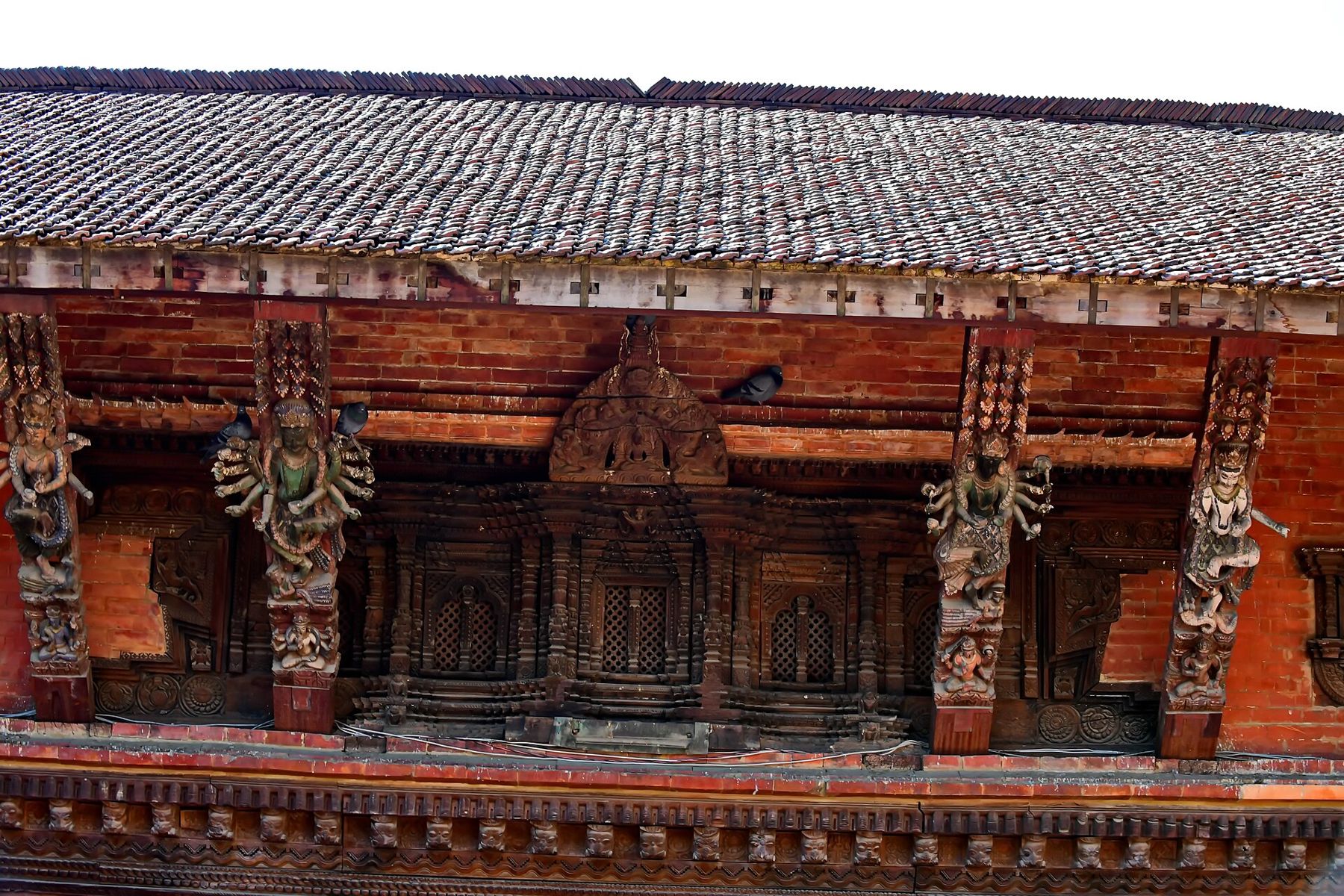
The same pattern appears at Hanuman Dhoka in Kathmandu and in Bhaktapur's palace. Seen after a few bahals, the palace courtyards make sense: they are the monastery square of the neighbourhood, raised to the scale of a kingdom.
Entering politely
Most courtyards are open to anyone who walks in quietly. A few habits keep it that way. Take off your shoes before stepping onto a shrine platform or into a shrine. Avoid leather near the sanctum where you see others doing so. Walk clockwise around chaityas and stupas. Do not touch images, offerings or the red and yellow powders on them, and never step over offerings on the ground.
Ask before photographing people, and before photographing inside any shrine. If a courtyard is clearly private, or a ceremony is under way and nobody waves you in, admire it from the passage and move on. A small donation in a box, where one is set out, is a good way to say thanks; the families who keep these places pay for their upkeep. For more on manners and getting around, see the guide to the valley on foot.
 Next in newar craft and customIndra Jatra, the festival of the living goddess