Newar craft and custom · Kathmandu Valley
Newar windows and the window without equal
The carved windows of the Newar cities are the valley's signature: lattice to see out without being seen, deities in the frames, and one Kathmandu window said to have no equal.
- Era
- Malla
- From Thamel
- A short walk south into the old city
- Bring
- A zoom lens or binoculars for upper storeys
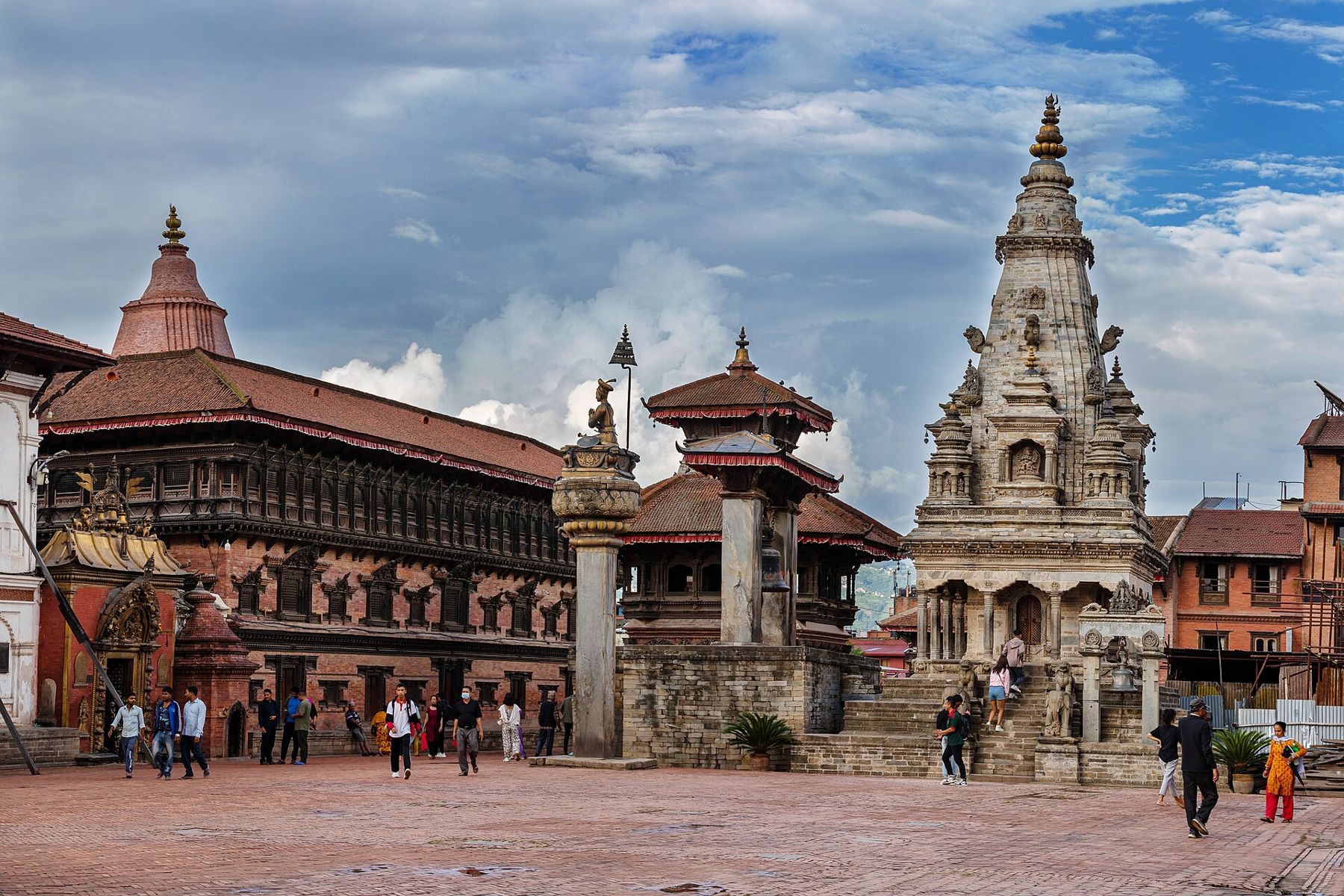
Walk any old lane in Kathmandu, Patan or Bhaktapur and look up. Above the shopfronts and the brick, the houses carry windows of dark carved wood: tight grids of lattice, frames edged with serpents and gods, whole bays that lean out over the street. For centuries Newar carpenters made the window the face of a building, and they made it with a care that still draws people from across the world.
This guide is for reading those windows: what the main kinds are, what the carvings show, and where to find the best of them, including the one Kathmandu calls the window without equal.
Wood, brick and the Newar house
The traditional Newar house is built of fired brick with a frame of timber, and its roof is carried on wooden struts. Windows and doors are the places where the timber shows. Carpenters worked mostly in sal, a hard and durable wood of the Himalayan foothills, and they assembled frames with pegged and slotted joints rather than nails, which let a window flex a little in an earthquake rather than crack.
The ground floor of a street house was often a shop or workshop, open to the lane. The upper floors were the family's, and the higher you go the more private the space becomes. Windows had to let in light and air while keeping the household out of view. That need shaped the most common Newar window of all.
The kinds of window
Lattice windows
The tiki jhya, or lattice window, fills its frame with a fine grid of small wooden pieces set at angles. From the street it reads as a dark screen. From inside, the household can watch the lane, the festival or the procession without being seen. Many lattices have a small central opening that can be swung open.
Bay windows
On grander houses and palaces the window grows into a bay that juts out over the street on carved brackets, with a row of panels across the front. Upper floors of palace courtyards often carry long runs of these bays, one after another.
Windows with figures
The frames themselves are carved. Lintels end in projecting ends, sometimes cut as animal heads; borders run with leaves, beads and serpents; and the top of the frame may hold a carved arch with a protective face at its peak. Small figures of deities, attendants and animals sit in the corners. The best windows are carved so deep that the frame becomes a set of tiny stages.
The Desay Madu Jhya
The most celebrated single window in Kathmandu is the Desay Madu Jhya. The name in Nepal Bhasa means roughly "the window found nowhere else in the country", and it is usually given in English as the window without equal. It sits in the upper storey of an ordinary-looking house on a lane in the old market quarter north of Kathmandu Durbar Square, among shops, which is part of its appeal: it is a masterpiece in a working street, not in a museum.
What makes it unique is its construction. Instead of a single lattice, the frame holds many small lattice panels set side by side and stacked, each with its own tiny frame, so that the whole window becomes a dense mosaic of screens. It dates from the eighteenth century, the late Malla period, when Kathmandu's carvers were at the height of their skill.
The window is easy to miss. Look for a small plaque and for other visitors gazing upward, and give yourself time to pick out its details. The guide to Maru and the old market lanes covers the streets around it.
Also in the valleyBhaktapur, the potters' cityThe Peacock Window and other famous frames
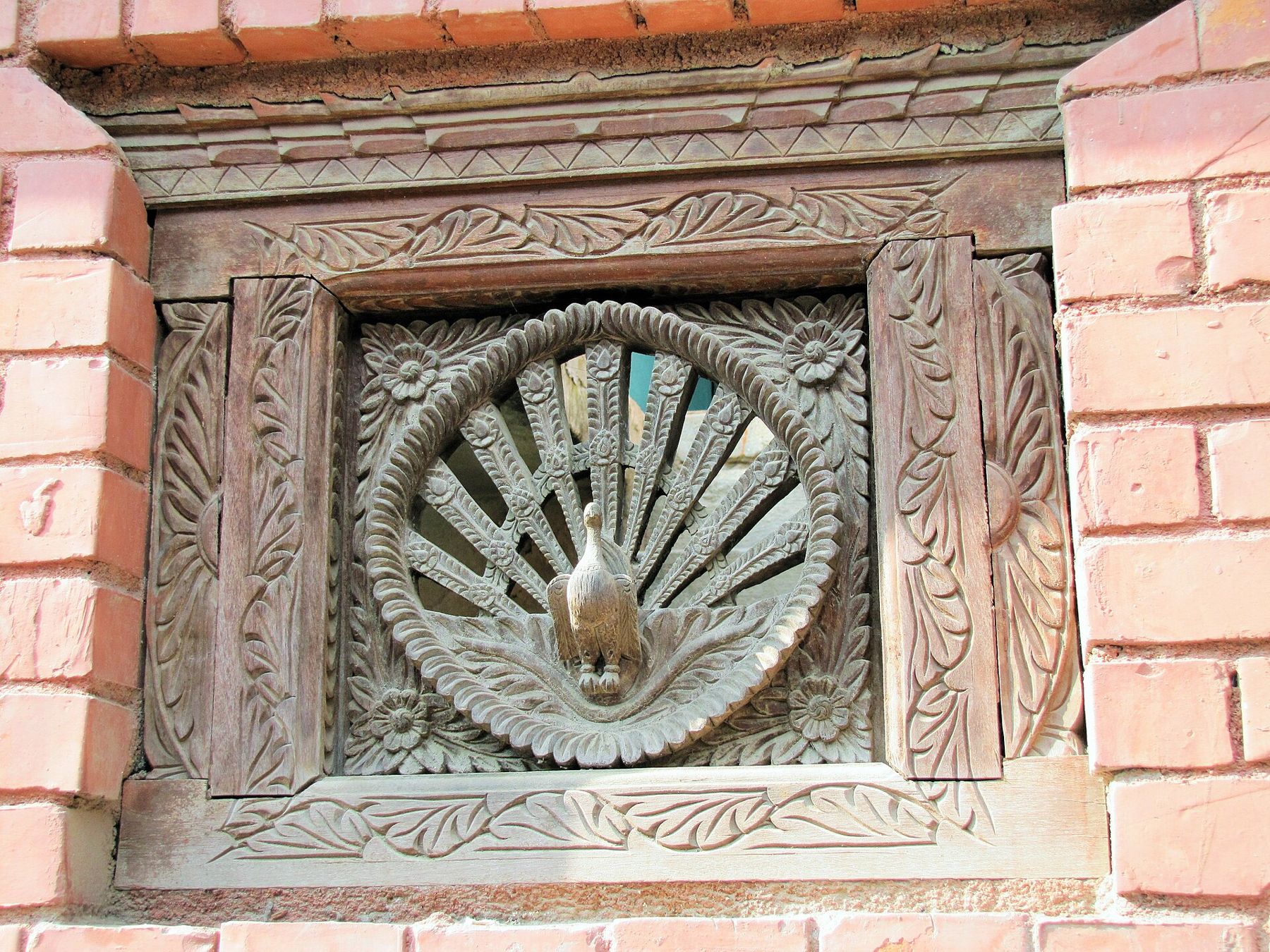
In Bhaktapur, in a lane beside the Pujari Math near Dattatreya Square, is the Peacock Window. At its centre a peacock spreads its tail in a fan of carved feathers, surrounded by a ring of smaller birds and leaves. It is the most photographed window in the valley, and the woodcarvers' quarter around it still produces copies in every size. The guide to Bhaktapur places it in a walk through the town.
The palaces are the other great galleries. In Bhaktapur, the palace on Durbar Square is known for its row of fifty-five windows. In Kathmandu, the courtyards of the old palace at Hanuman Dhoka and the facade of the Kumari Ghar, the house of the living goddess, are framed in fine carving; see the guide to Kathmandu Durbar Square. In Patan, the Patan Museum, set inside part of the old palace, lets you study windows and doors at close range, in good light, at eye level.
Damage and repair
Wood decays, and Newar windows have always needed care. Many old houses were lost to fire, rot, the earthquake of 1934 and the rebuilding fashions of the twentieth century, when concrete and glass replaced timber on many streets. The earthquake of 2015 damaged or brought down further old buildings, and many windows were salvaged from the rubble, stored and later refitted.
Rebuilding has kept the carvers busy. In Bhaktapur and Patan especially, workshops cut new struts, doors and windows by hand, following old patterns. When you see bright, pale wood among the dark, you are often looking at a repair. Some craftspeople argue for exact copies, others for honest new work; both views are part of a living craft, not a finished one.
How to look
The best windows are often on upper storeys, so stand back on the far side of the lane, or find a step or temple plinth that lifts you a little. Morning and late afternoon light picks out the carving best. A pair of binoculars or a long lens helps with the small figures in the frame.
Remember that most windows belong to private homes. Look and photograph from the street, do not climb onto doorsteps or ledges, and if someone appears at the window, lower the camera. The houses are lived in, which is why the windows have lasted at all.
 Next in newar craft and customIndra Jatra, the festival of the living goddess