Newar craft and custom · Kathmandu
Indra Jatra, the festival of the living goddess
For eight days in late summer, Kathmandu's old city fills with masked dancers, chariots and gods on display, and the Kumari is carried through the streets that her blessing once handed to Gorkha.
- Era
- Living tradition
- From Thamel
- Walk south to Durbar Square
- Bring
- Patience, small bag, water, respect for crowds
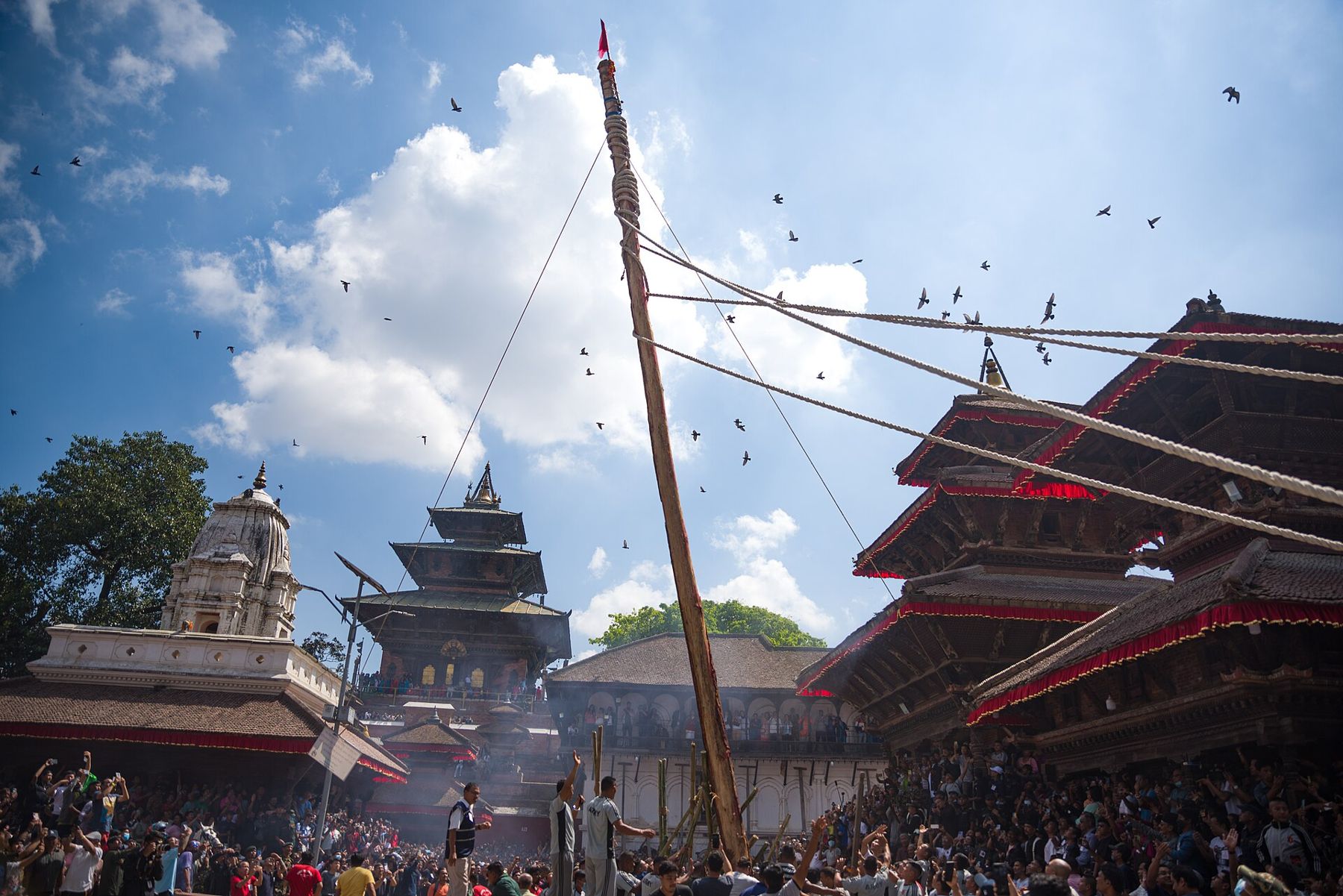
Indra Jatra, called Yenya in Nepal Bhasa, is the great festival of Kathmandu's old city. For eight days at the end of the monsoon, usually in September, the streets around Durbar Square fill with masked dancers, music, shrines decorated with lamps, and the chariots of the living goddess and her companions. It is a festival of the god Indra, of the dead, of the harvest to come, and of the city itself.
It is also the festival during which Kathmandu changed hands. In September 1768, as the city celebrated, the forces of Prithvi Narayan Shah of Gorkha entered it, and the Malla dynasty of Kathmandu came to an end. The festival has carried that memory ever since.
The yosin pole
Indra Jatra begins with the raising of the yosin, a tall wooden pole set up in front of the Hanuman Dhoka palace. A tree is chosen and cut in the forest outside the valley, then dragged into the city by teams of men, a task bound by ritual and tradition. On the first day, with ropes and much effort, the pole is hauled upright, with a banner of Indra at its top. Its raising marks the start of the festival, and its lowering on the last day marks the end.
Being in the square for the raising is one of the great experiences of the festival, but the crowds are dense. Find a place on a temple step early, keep your belongings close, and be ready to move with the crowd.
Indra and his mother
The festival tells a story. Indra, king of the gods, came down to the valley in disguise to gather parijat flowers for his mother. Caught in the act, he was bound like a common thief and displayed to the people. His mother came searching for him and, when the people learned who he was, they released him. In gratitude, the story goes, Indra's mother promised dew and mist for the crops through the winter, and agreed to lead the souls of those who had died that year to heaven.
During the festival you will see images of Indra with his arms outstretched, as if bound, displayed on platforms around the old city. Families who have lost someone in the past year walk a long procession around the city in their memory, lighting lamps along the way.
In the evenings, the old neighbourhoods light oil lamps along the processional routes, and small shrines that are closed for most of the year open their doors. Musicians play drums and cymbals at street corners, groups of neighbours gather to share food and drink, and the city feels like a series of village festivals held side by side. The best way to see this is simply to walk the lanes north of Durbar Square after dark, towards Indra Chowk and Asan, and let the sounds lead you.
The Kumari's chariot
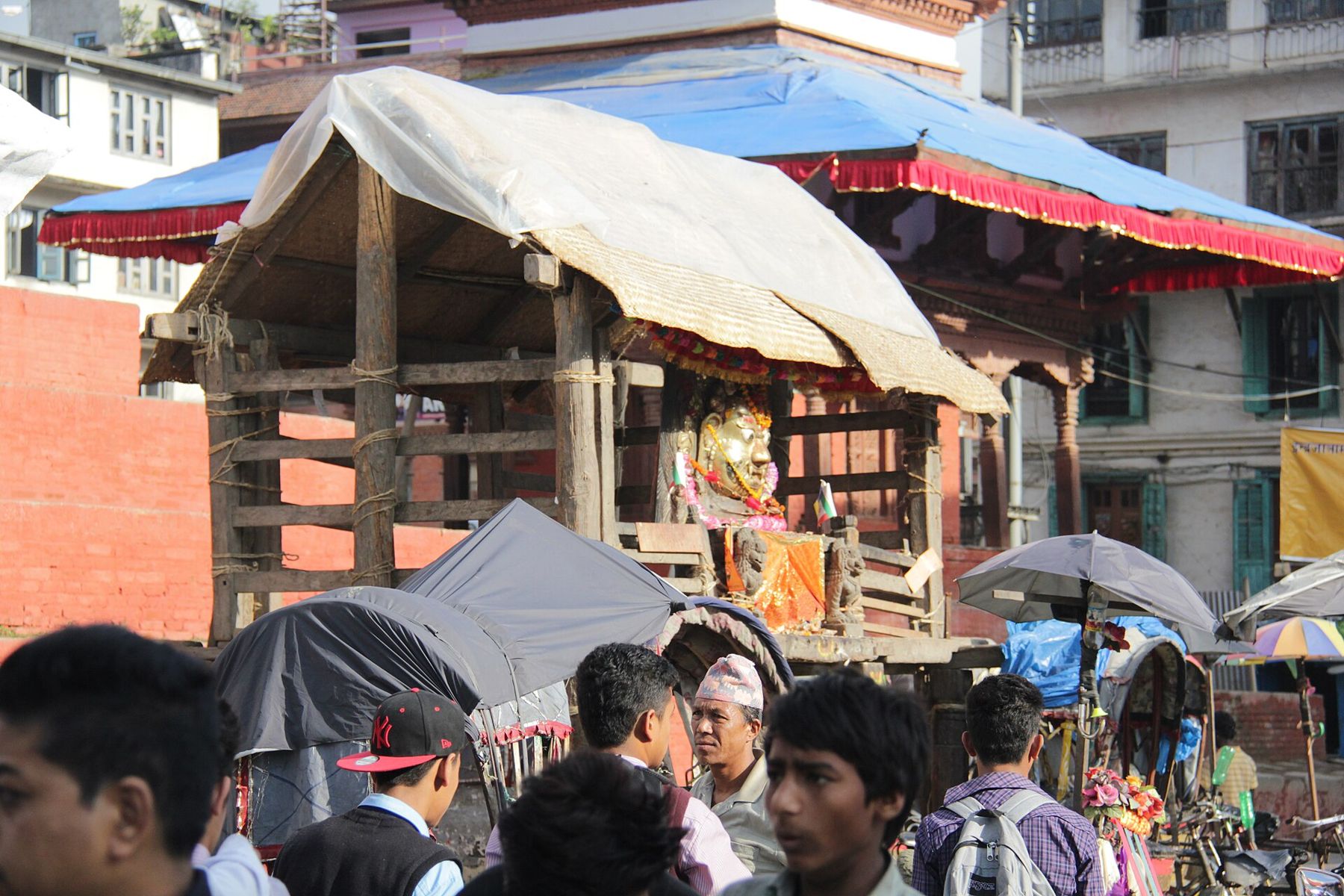
The heart of the festival for many people is the Kumari Jatra, the procession of the living goddess. The Kumari is a young girl from a Newar Buddhist family, chosen by strict signs and worshipped as the goddess Taleju until she reaches puberty. She lives in the Kumari Ghar on Kathmandu Durbar Square and rarely appears in public. During Indra Jatra she is carried out and placed in a tall wooden chariot, which is pulled through the old city on several days, followed by the smaller chariots of Ganesh and Bhairab, each with a boy who represents the god riding in it.
The chariot procession was established in the eighteenth century by Jaya Prakash Malla, the last Malla king of Kathmandu. On one day of the festival, the Kumari gives her blessing, a tika, to the head of state. For centuries that was the king; since the end of the monarchy in 2008, it has been the president.
Also in the valleyKathmandu Durbar Square, Hanuman Dhoka and the old palaceBhairab, Lakhe and the dancers
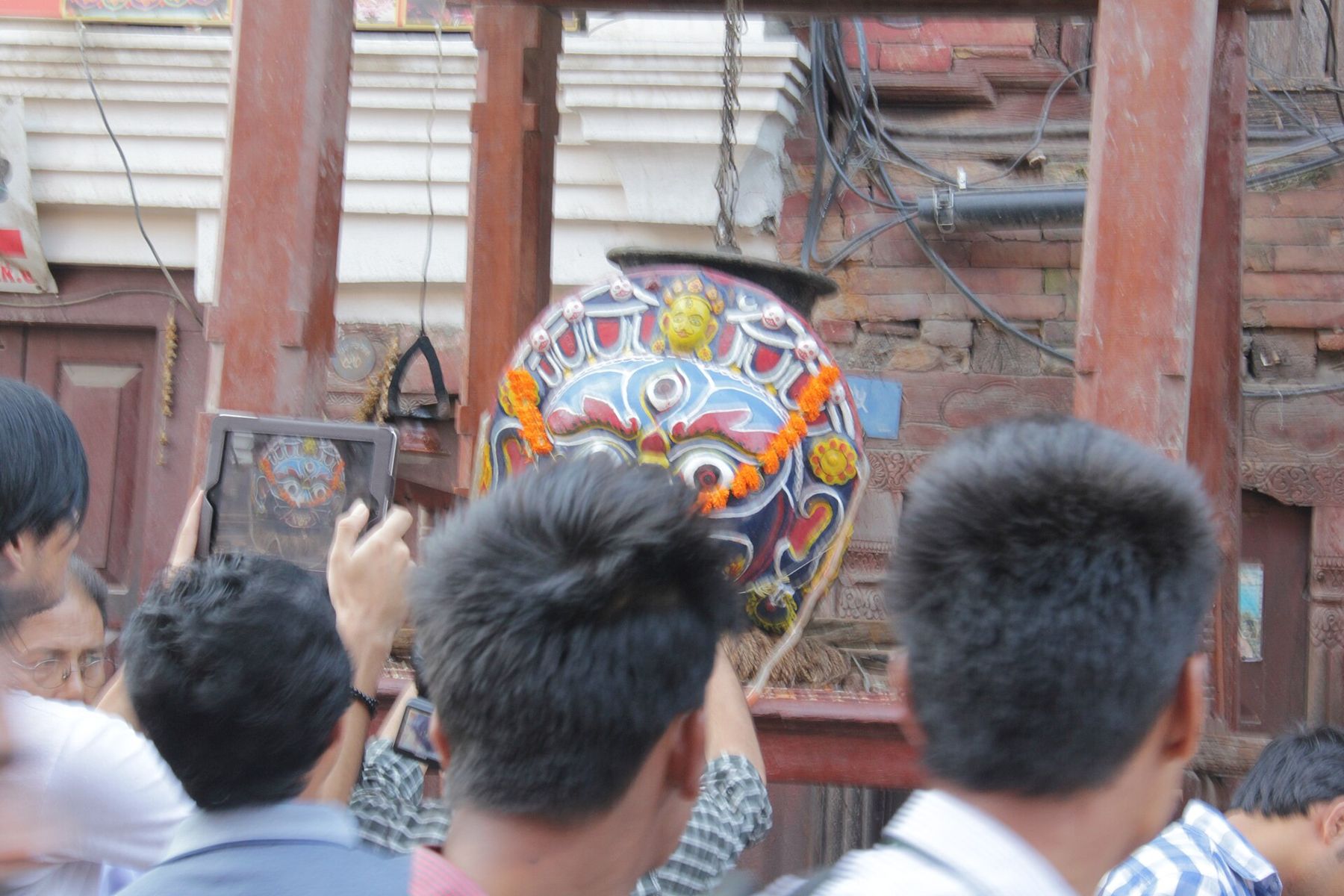
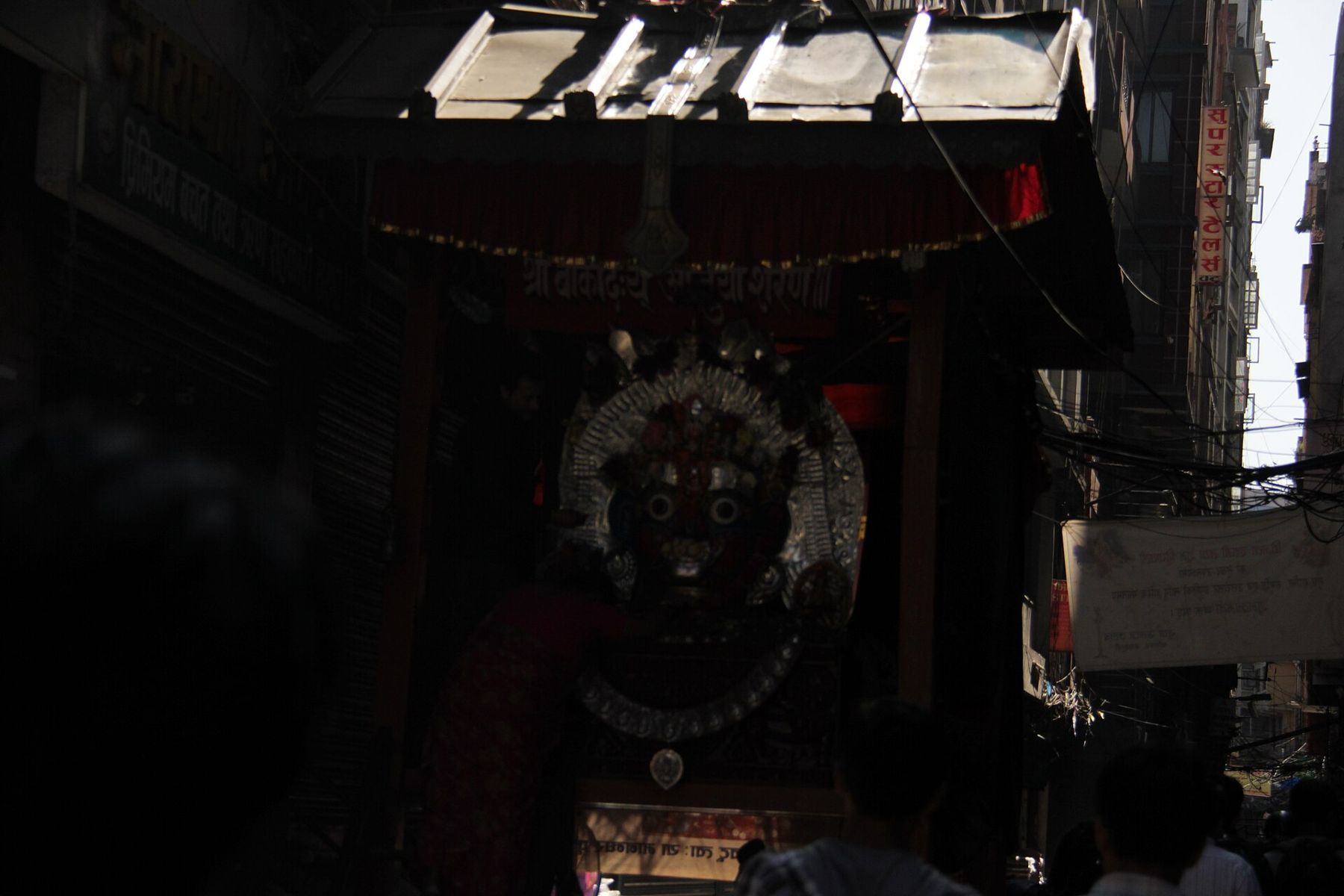
Bhairab, the fierce form of Shiva, is everywhere during Indra Jatra. At Hanuman Dhoka, the great mask of Sweta Bhairab, White Bhairab, is uncovered for the festival only. At certain times, rice beer flows from a pipe in its mouth, and people crowd forward to drink it; catching a small fish that is said to swim in the beer brings luck. At Indra Chowk, the mask of Akash Bhairab is displayed in the street, and other Bhairab masks appear at shrines across the old city.
The dancers bring the festival to life. Lakhe, a demon with a fierce red mask and long hair, dances through the streets, leaping and spinning, and children both fear and love him. Pulu Kisi, an elephant made of cloth and bamboo, runs through the crowds in search of his master Indra. On the platform before the Kumari Ghar, masked dancers perform scenes of the ten incarnations of Vishnu over several nights.
1768: the festival and the conquest
Prithvi Narayan Shah had spent twenty-five years closing in on the valley. By 1768 Kathmandu was weakened by blockade and by its quarrels with Patan and Bhaktapur. On the night of the festival, while King Jaya Prakash Malla and the city were celebrating, the Gorkhali army entered Kathmandu. The king fled to Patan. In the story, Prithvi Narayan Shah sat in the seat prepared for the king and received the Kumari's tika, as if the goddess herself had handed him the city.
Whether every detail of the story is true, it has shaped the way the festival is remembered. For some it marks the founding of modern Nepal; for others, the end of the Malla city. Both memories live in the crowd. The wider campaign is traced in the guide to the unification route, and the hard siege that came before it in Kirtipur.
Whether every detail of the story is true, it has shaped the way the festival is remembered.
Being there
The dates of Indra Jatra follow the lunar calendar, so they change every year. The busiest days are the raising of the pole and the days of the Kumari's procession, when the streets around Durbar Square are packed. Arrive early, choose a spot with a way out, and keep valuables close. Do not photograph the Kumari with flash, and follow any instructions from the people who look after her. If a dancer or a procession comes towards you, step aside.
The festival is a living tradition, not a performance for visitors. You are welcome to watch, but remember that much of what you see is worship. Take part where you are invited, keep a respectful distance where you are not, and let the old city show you how it celebrates.
 Next on the roadPatan, the city of fine arts