Shrines on the valley rim · Kathmandu
Swayambhunath, the hill of the self-arisen stupa
On a wooded hill west of the old city, a white dome with painted eyes watches over the Kathmandu Valley. Climb the long eastern stair at dawn and join the pilgrims walking round it.
- Era
- Many eras
- From Thamel
- A short taxi ride or walk west
- Bring
- Water, no loose food, and something for the climb
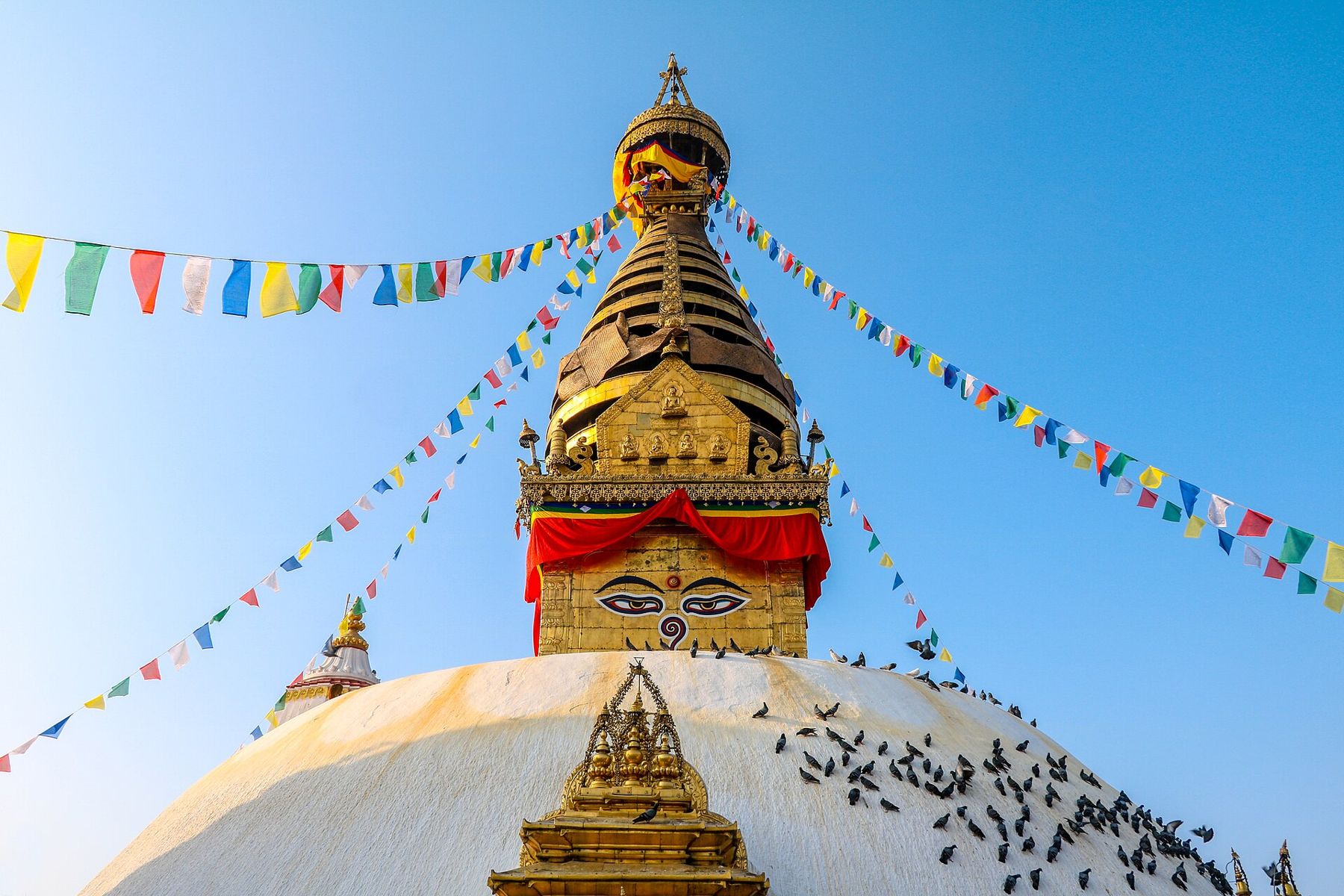
Swayambhunath stands on a small, steep hill just west of Kathmandu's old city, across the Vishnumati river. From the top, the whole valley spreads out below: the brick of the old city, the newer concrete beyond it, and on clear days the line of hills and snow peaks around the rim. At the centre of the hilltop is a great white stupa, its gilded tower painted on all four sides with a pair of watching eyes.
It is one of the holiest Buddhist sites in Nepal, revered by Newar Buddhists and by Tibetan Buddhists alike, and it is also full of Hindu shrines. Visitors often call it the Monkey Temple, after the troops of macaques that live in the trees around it.
The legend of the lake
Swayambhu means "self-arisen" or "self-existent". The founding story, told in the Swayambhu Purana, begins long ago when the Kathmandu Valley was a great lake. A lotus grew on the water, and from it shone a light that had arisen by itself. Pilgrims came to worship it.
Then the bodhisattva Manjushri, wishing to make the light accessible, cut a gorge through the hills at the valley's southern edge with his sword. The lake drained out, the valley floor became fertile land for people to settle, and the light of the lotus was enshrined on the hill where the stupa now stands. The gorge at Chobhar, where the Bagmati leaves the valley, is still pointed out as Manjushri's cut. Geologists agree, in their own way, that the valley was once a lake.
The climb from the east
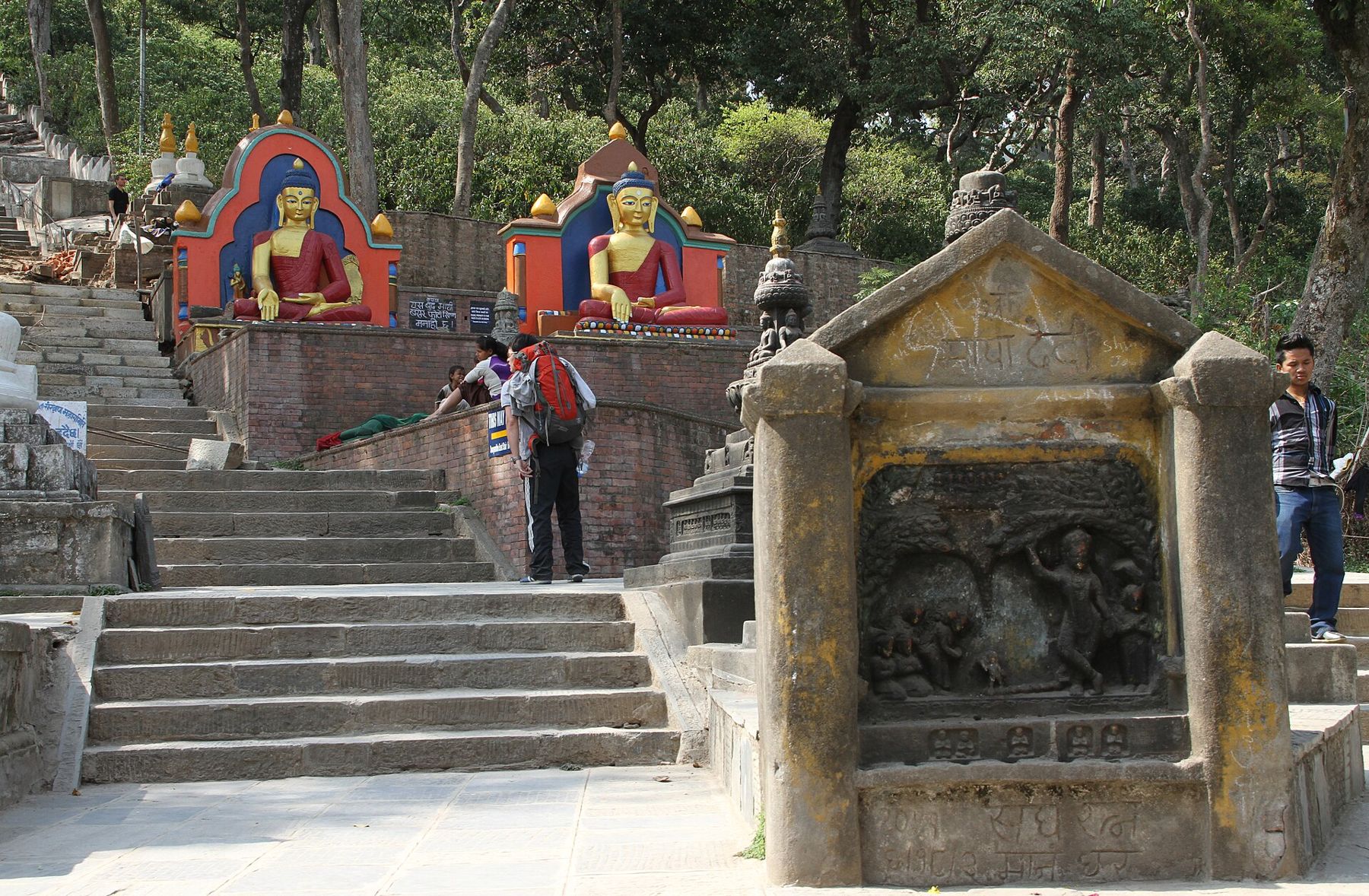
The traditional approach is the long stone stairway up the eastern side of the hill, often said to have 365 steps. It starts at the foot of the hill among trees, beside large painted images of the Buddha, and climbs steeply between old stone carvings, small chaityas and stalls. Monkeys play on the handrails and steal anything that looks like food, so keep snacks out of sight.
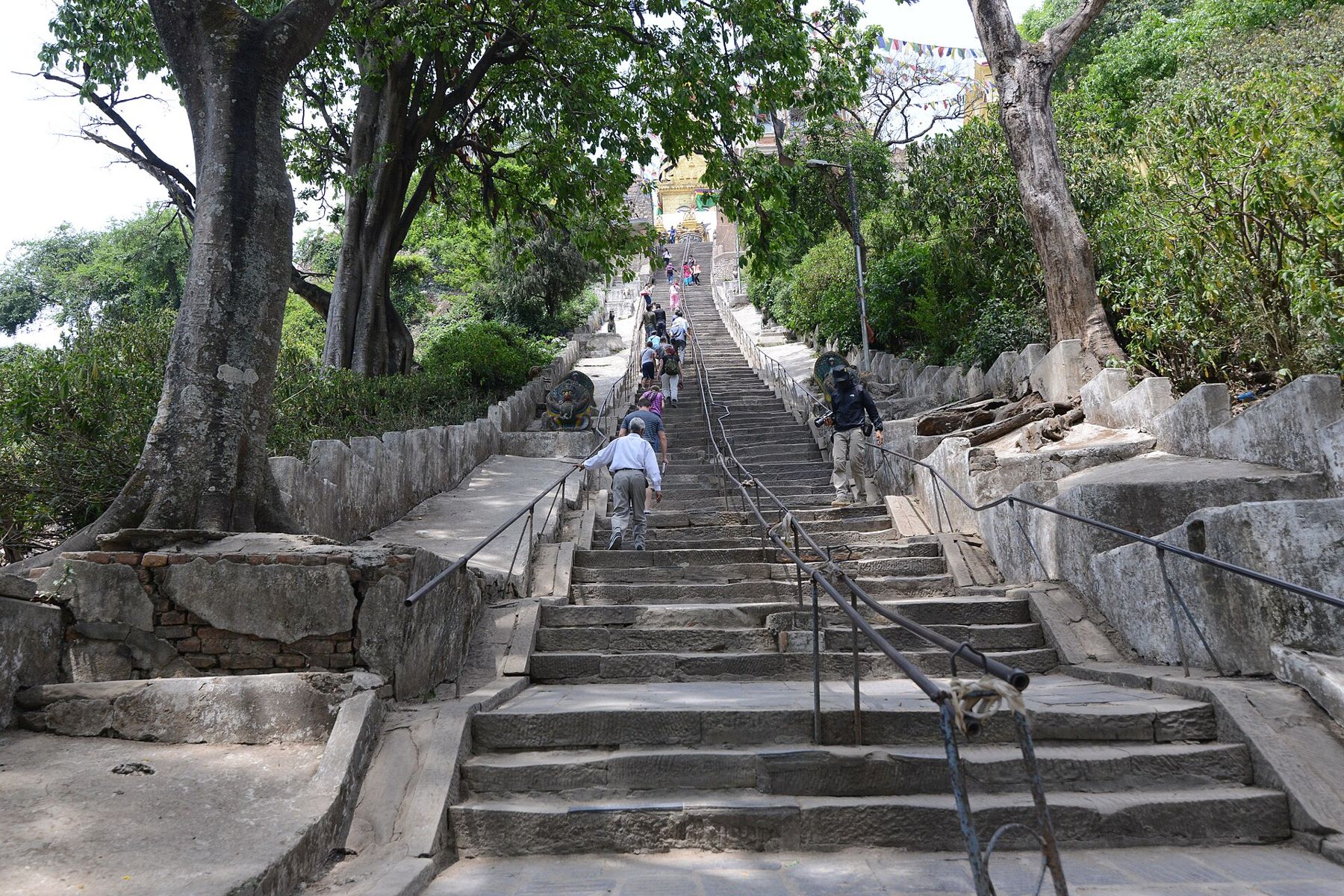
The climb takes some effort but no special fitness; stop as often as you like and look back over the city. There is also a road to the western side of the hill, where a gentler approach leads in, if the stairs are too much.
The stupa and its eyes
At the top of the eastern stairway you arrive at a huge gilded vajra, the thunderbolt symbol of Vajrayana Buddhism, set on a round base carved with the animals of the Tibetan calendar. Behind it rises the stupa.
The white dome represents the world and its emptiness. On top sits a gilded cube, the harmika, painted with the eyes of the Buddha looking out in the four directions. Between the eyes is a curled sign shaped like a question mark; it is the Nepali numeral one, read as a symbol of unity. Above the harmika rise thirteen gilded rings, the stages on the path to enlightenment, and a parasol at the summit.
Around the base are niches with gilded images of the Buddhas of the five directions, and rows of prayer wheels that pilgrims spin as they walk. Like every stupa, it is circled clockwise. The guide to Boudhanath describes the other great stupa of the valley, which is larger but younger in its present form.
The temples around it
The hilltop is crowded with shrines, monasteries and small stupas. Beside the main stupa stand two tall shikhara-style towers, and close beside it is the temple of Harati, a goddess honoured by Buddhists and Hindus as the protector of children, where families come to make offerings. There are Tibetan monasteries with prayer halls, rows of butter lamps and stone slabs carved with mantras.
Shrines on the hill were damaged in the earthquake of 2015, and several have since been repaired or rebuilt. You may see scaffolding on some buildings; the work of repair at a site like this never quite stops.
Behind the main platform, a path leads to a second hilltop with a shrine to Manjushri, a quieter spot that many visitors miss.
Dawn and dusk
The best time to visit is early morning. Before the day's visitors arrive, local people climb the stairs to walk round the stupa, spin the prayer wheels and make offerings. The light is soft, the air is clearer than at midday, and the sound of bells and chanting carries across the hill.
Many local people make the climb part of a daily routine, walking up before work and down again within the hour. Walking with them, at their pace, is a good way to feel the hill as a place of practice rather than a sight.
Late afternoon is good too, especially after rain, when the haze lifts and the hills around the valley stand out. Buddhist festivals bring large crowds, notably the full moon of Buddha Jayanti in spring.
Visiting well
Foreign visitors pay an entry fee to the site. Walk clockwise around the stupa and the chaityas. Remove your shoes where others do before entering prayer halls, and ask before photographing monks or people at worship.
Keep food and drink packed away, and do not feed or tease the monkeys: they are wild, quick and sometimes bold. Hold on to sunglasses and small bags near the trees.
From Swayambhunath, the old city is a short taxi ride or a walk back east across the river. Combined with Kathmandu Durbar Square, it makes a full day; a slow morning on the hill is reason enough on its own.