Shrines on the valley rim · Kathmandu
Boudhanath and the evening kora
East of Kathmandu, one of the largest stupas in the world draws pilgrims round its base from dawn until dark. Join the clockwise walk at dusk, when the lamps are lit.
- Era
- Many eras
- From Thamel
- A taxi or bus north-east
- Bring
- Small notes for lamps, a scarf, an unhurried evening
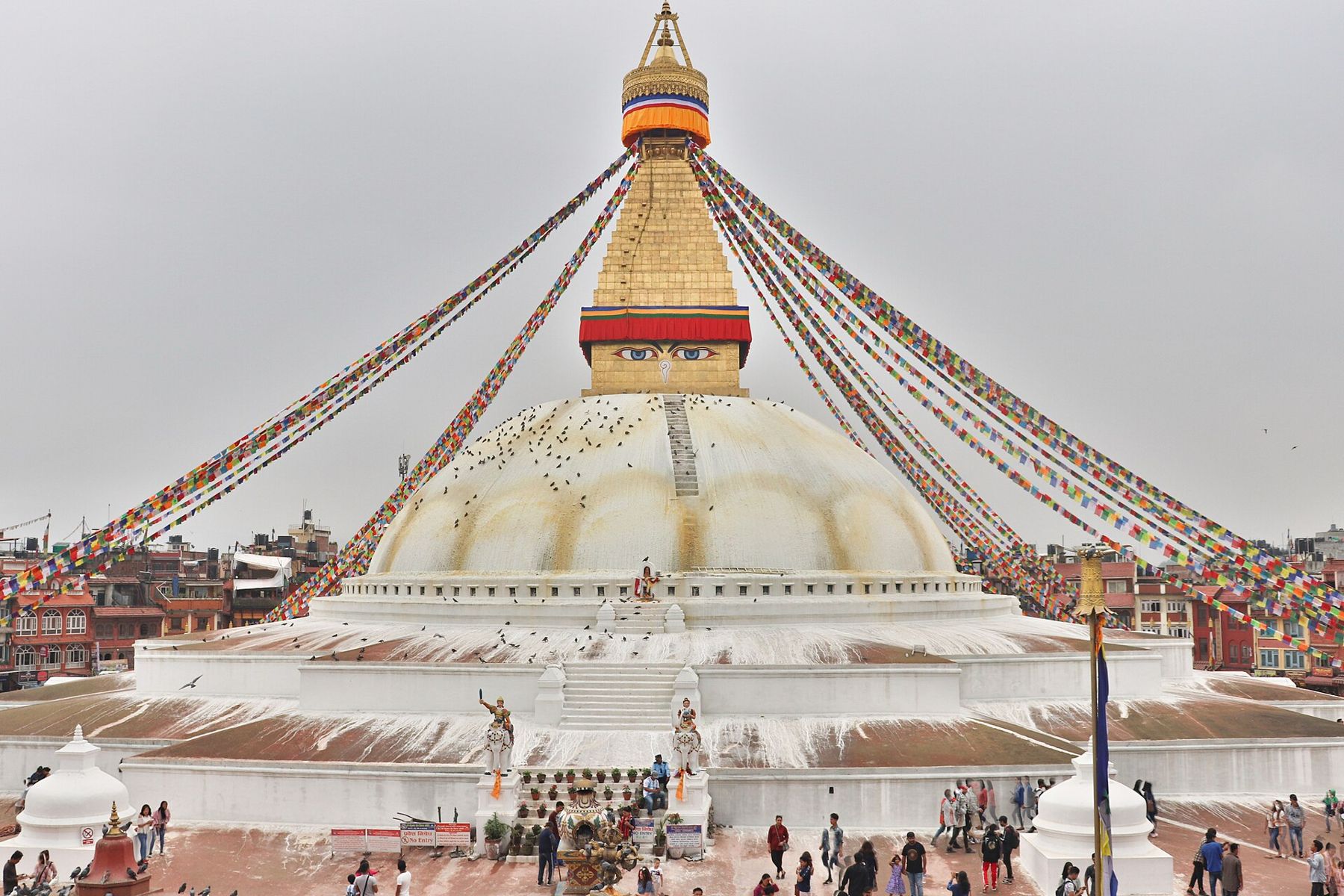
Boudhanath, called Boudha by most people and Khasti by the Newars, is one of the largest stupas in the world. It rises from a ring of houses and monasteries north-east of Kathmandu, a vast white dome on three stepped terraces, crowned by a gilded tower with the painted eyes of the Buddha. Around it, from early morning until after dark, a steady stream of people walks clockwise: monks and nuns, elderly pilgrims spinning prayer wheels, families, students and visitors.
That walk, the kora, is the heart of the place. Spend an hour on it, and Boudha makes more sense than any guide can make of it.
A stupa on the road to Tibet
The stupa stands on the old trade and pilgrim route that ran from the Kathmandu Valley north towards Tibet. Its first foundation is often attributed to the Licchavi period, more than a thousand years ago, though the details are uncertain and the present structure reflects many rebuildings since. For centuries Tibetan traders and pilgrims passed by and paid their respects, and the stupa became a focus for Tibetan Buddhism in the valley.
After 1959, when many Tibetans left their homeland, a large number settled around Boudha. Monasteries of the major schools of Tibetan Buddhism were built in the lanes around the stupa, and the area became a centre of Tibetan religious life outside Tibet. Today Newars, Tibetans, Sherpas and other Himalayan peoples, as well as students of Buddhism from around the world, live and study there.
Reading the stupa
Seen from above, Boudha is a mandala: a circle within a series of terraces and corners laid out to represent the cosmos. The three terraces at its base can be climbed by a stairway on the north side. The dome above them represents the world; the harmika, the square tower on top, carries the eyes of the Buddha looking out in four directions, with the curled sign for the number one between them. Above that, thirteen tiers mark the stages towards enlightenment.
Around the base, a wall holds rows of prayer wheels, each one inscribed with the mantra om mani padme hum, and niches with small images. Long strings of prayer flags run from the spire to the edge of the terraces, carrying prayers on the wind.
Also in the valleySwayambhunath, the hill of the self-arisen stupaDamage and the rebuilt spire
The earthquake of 2015 cracked the stupa's upper section. The harmika and the tiers above it were taken down and rebuilt, with funds and labour raised largely from Buddhist communities and local people, and the stupa was reconsecrated in late 2016. It was among the first major monuments in the valley to be restored after the disaster, and the bright gilding on the spire is the result of that work.
The houses around the ring were also damaged in places, and you will notice newer facades among the old. Most of the monasteries in the surrounding lanes have been repaired.
Walking the kora
The kora is simple: you walk round the stupa clockwise, keeping it on your right. That is the one firm rule. Many people walk round three times, some many more. As you go, you can spin the prayer wheels set into the wall with your right hand, clockwise, as others do.
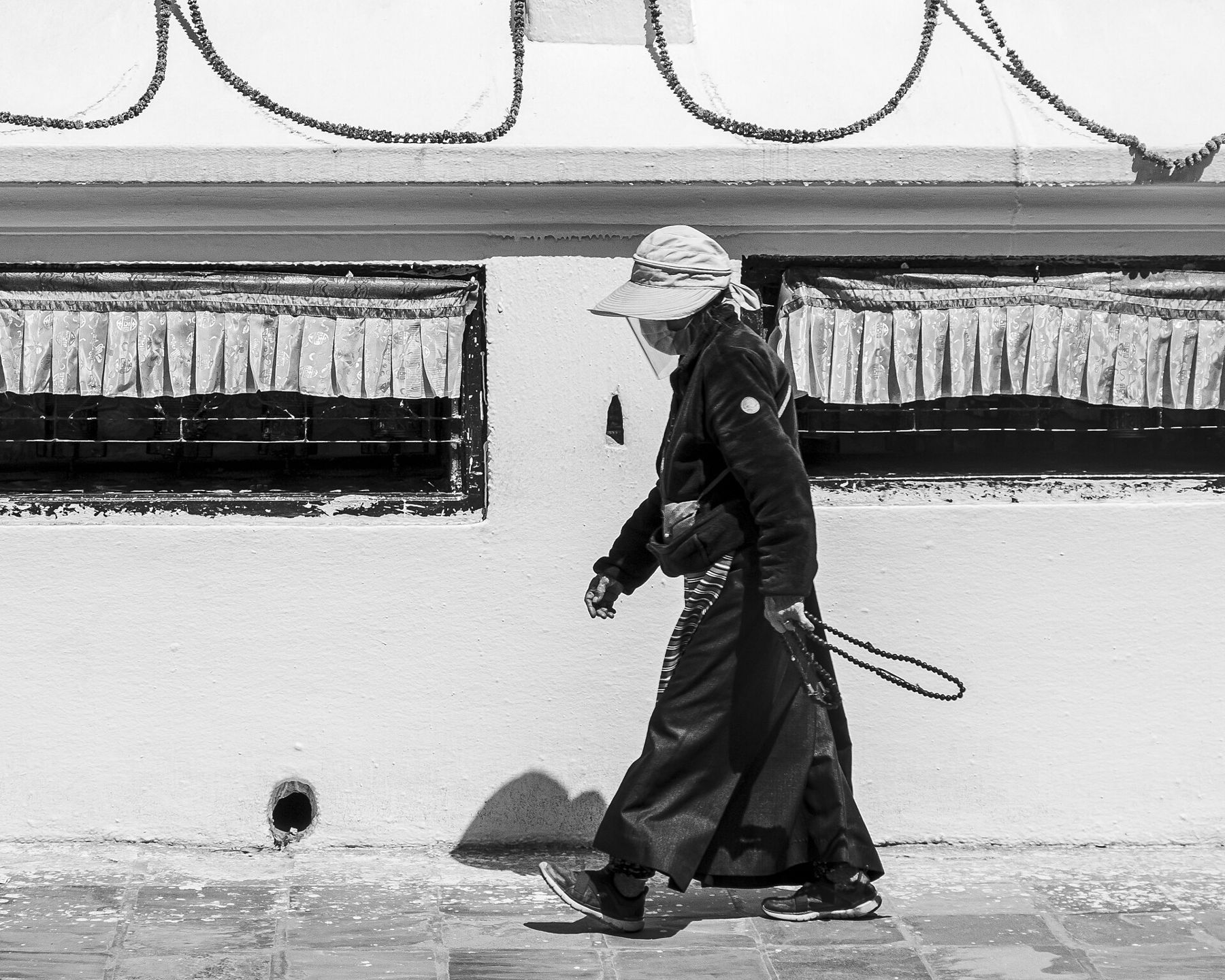
The walk is busiest at dawn and in the evening, when people come after work. As dusk falls, butter lamps are lit in lamp houses and on the terraces, the white dome turns grey and then gold in the lamplight, and the chanting from the monasteries carries into the square. Full-moon days are especially busy, and the Tibetan new year, Losar, in late winter, brings large crowds, dances and masses of new prayer flags.
There is no need to hurry. Some walkers carry prayer beads and murmur mantras, others chat with friends, and some stop to sit on the steps of the houses around the ring and watch. Benches and doorsteps fill with elderly people who have walked the circuit every day for years. If you want to slow down, do the same, and let the circle pass you by.
You can join a lamp offering at one of the lamp houses for a small donation. Lighting a lamp is open to anyone who does it respectfully.
The monasteries around the stupa
In the lanes behind the ring are dozens of monasteries, called gompas. Many welcome quiet visitors to their main prayer halls, which are painted with Buddhist scenes and hung with silk banners and thangka paintings. If you hear chanting, you can often step inside and sit at the back.
Take off your shoes before entering, walk clockwise inside the hall, do not point your feet towards the altar or the monks, and ask before taking photographs. Some halls are closed at certain times; follow any signs and the lead of the monks.
Visiting well
Foreign visitors pay an entry fee to the Boudha area. The ring is lined with buildings, many with upper terraces facing the stupa, from which you can watch the kora from above at dusk.
Dress modestly, keep your voice down near the prayer halls, and step aside for people prostrating on the paving, some of whom spend hours at their practice. Never walk anticlockwise against the flow, and do not climb the terraces anywhere except by the open stairway.
Boudha is a short ride from Pashupatinath, and many visitors combine the two, moving from Shiva's temple on the Bagmati to the Buddhist stupa in the same afternoon. The contrast says much about how the valley holds its faiths side by side; the guide to Swayambhunath covers the other great stupa, on the hill west of the city.