The royal cities · Kathmandu
Kathmandu Durbar Square, Hanuman Dhoka and the old palace
The royal square of Yen, the old Kathmandu, where Malla kings built temples to outdo their rivals and the Shah kings later took the throne: a slow walk from Basantapur to the Taleju temple.
- Era
- Malla
- From Thamel
- A twenty-minute walk south through the bazaar
- Bring
- Small notes, a scarf, comfortable shoes, patience
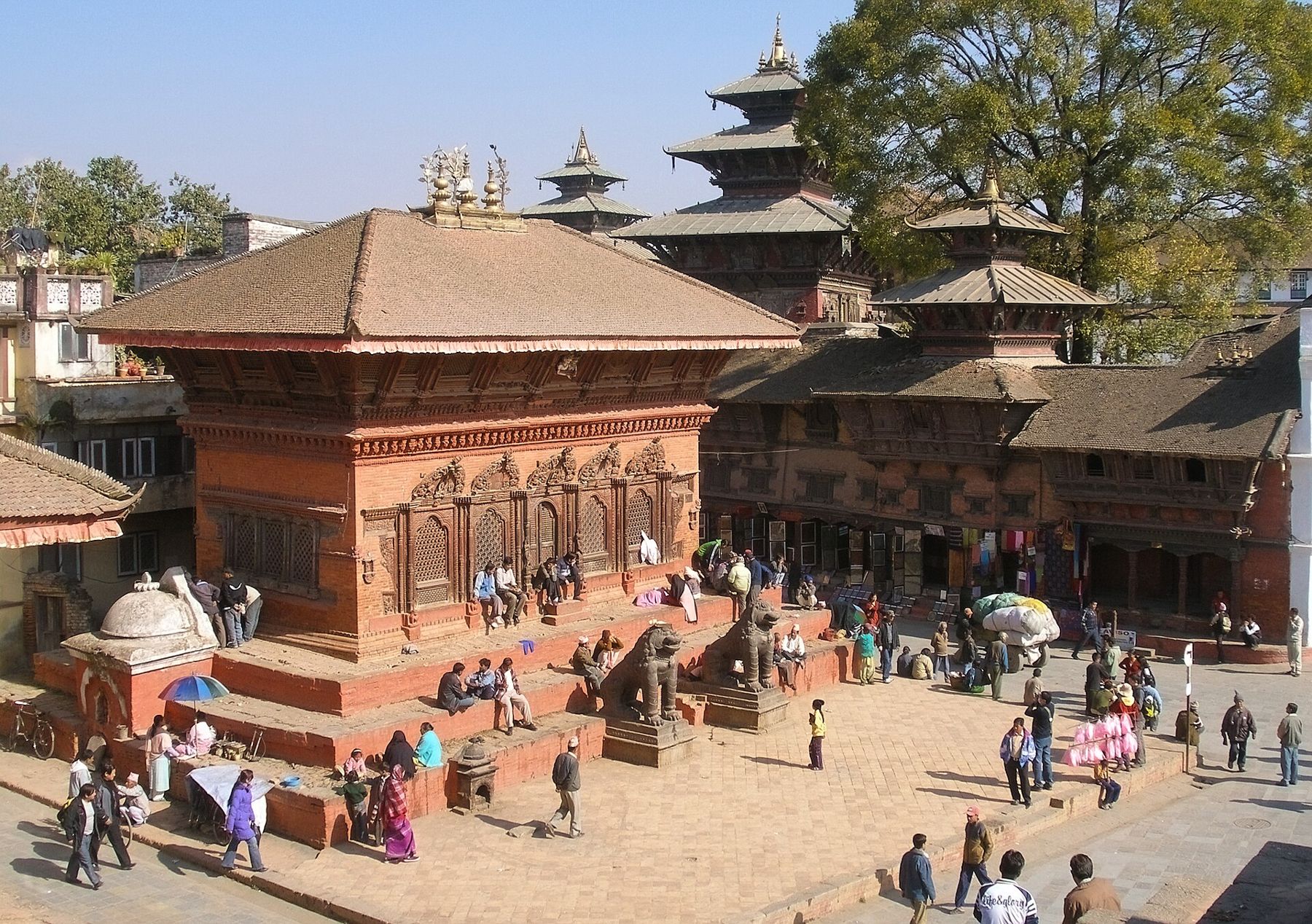
Kathmandu Durbar Square is not one square but a chain of open spaces running from Basantapur in the south to the Taleju temple in the north, stitched together by brick platforms, stone lions and the long front of the old palace. Newar speakers call the city Yen, and for most of the Malla centuries this was the seat of its kings. When Prithvi Narayan Shah of Gorkha entered the city in September 1768, during the festival of Indra Jatra, it became the seat of his dynasty too, and Shah kings were crowned inside the palace well into the twentieth century.
The square rewards slow walking more than ticking off. Give it a morning, come back in the late afternoon when the platforms fill with people sitting out the day, and let the order of buildings sort itself out in your head on the second pass.
Basantapur and the southern end
Most people arrive at Basantapur, the broad paved plaza at the southern end. On its northern side rises the tall tower of the palace, built after the Gorkhali conquest so that the new rulers could look out over the city they had taken. It was badly damaged in the earthquake of April 2015, and much of the work of the following years went into propping and rebuilding it. The plaza itself has long been a market space; on many days you will find stalls of metalwork, beads and prayer wheels spread across the paving.
At the corner where Basantapur meets the temple square stands the Kumari Ghar, the house of the living goddess. It is a three-storey brick building with deeply carved windows, raised in the eighteenth century by Jaya Prakash Malla, the last Malla king of Kathmandu. You may step into its courtyard. The Kumari, a young girl from a Newar Buddhist family who is worshipped as the goddess Taleju, sometimes appears briefly at an upper window; photographing her is not allowed, and the people who keep the house will remind you.
The temple square
North of the Kumari Ghar the space opens into the heart of the old square. The tall Maju Dega, a Shiva temple on a nine-stepped plinth, is the place everyone climbs to sit and watch. Opposite stands the Shiva Parvati temple, a broad two-roofed building whose upper window frames the carved figures of Shiva and his consort looking down on the crowd. Between them, the stone steps of the platforms work as seating, meeting place and lookout at once.
Walk on and the buildings become denser: the Kal Bhairav, a large stone image of Shiva's fierce form, painted black and gold and set against a wall; the great drums and the bell under their own roofs; small shrines to Ganesh at almost every corner. Several temples on this part of the square fell in 2015, and you will see some rebuilt in fresh timber and brick beside others that survived. The fresh wood is a sign that the old crafts are still alive, not a loss.
The fresh wood is a sign that the old crafts are still alive, not a loss.
Hanuman Dhoka, the palace gate
The palace takes its name from the statue of Hanuman, the monkey god, beside its main gate. He stands on a plinth under a red umbrella, his face long since hidden under layers of red paste left by worshippers, and the gate behind him is guarded by painted stone lions. Hanuman was the protector the Malla kings chose for their door, and he has kept the post through every change of ruler since.
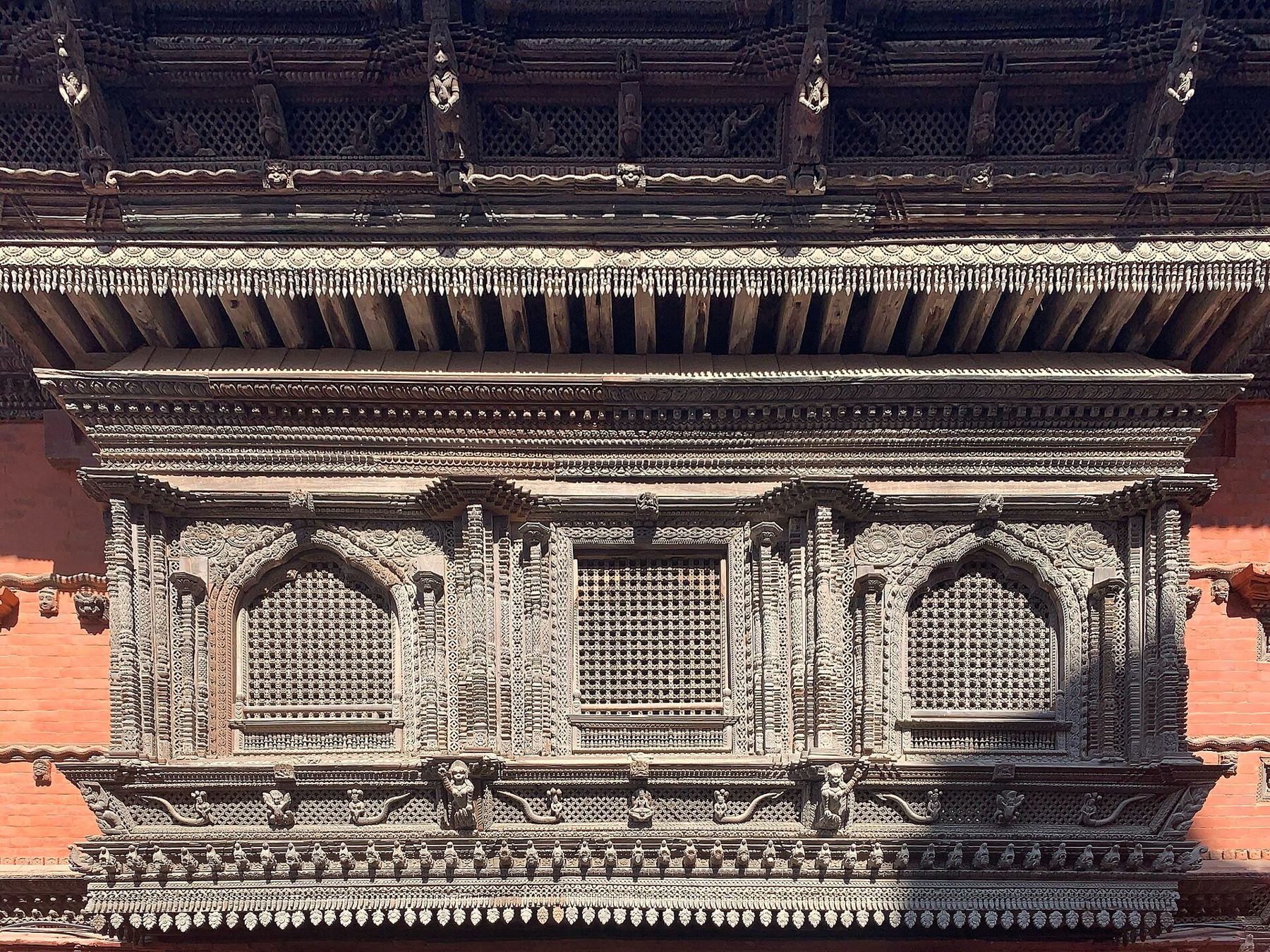
Inside lies a sequence of courtyards. The largest, Nasal Chowk, was the stage for royal ceremonies, including coronations of the Shah kings. Its wooden galleries are carved with struts showing deities in their many forms, and the facades around the inner courts carry some of the finest window work in the city. Parts of the palace hold museum displays on the Shah kings, and access to some courts depends on repair work, so expect certain doors to be closed. If the windows draw you in, the guide to Newar windows explains what to look for in the lattice and the frames.
Taleju and the northern square
At the northern end, the Taleju temple rises on a high stepped base above the rest of the square. Taleju was the tutelary goddess of the Malla kings, brought from the south and installed in each of the three valley capitals; the temple here is the tallest of the old square's buildings. It is usually closed to the public, opening only on certain festival days, and even then entry has traditionally been restricted. Treat it as a building to admire from below. Its gilded roofs catch the late light, which is one reason to stay into the evening.
Below it, the lanes run north towards Indra Chowk and Asan, the old trading crossroads of the city. Following them on foot is the best way to understand how the palace and the bazaar fed each other: the kings needed merchants and craftsmen, and the merchants needed the protection of the court. From the southern end, a short walk west brings you to Maru and the Kasthamandap, the old pavilion that gave Kathmandu its name.
After the earthquake
The earthquake of 25 April 2015 hit the square hard. Several temples collapsed completely, the palace tower was left cracked and leaning, and many buildings needed shoring with timber props for years afterwards. Rebuilding has been slow and careful, partly because much of it uses traditional methods: hand-made bricks, carved wood, and joints that let a structure move rather than break. Some work was finished within a few years, while other buildings were still under repair long after. Expect scaffolding in places and treat it as part of the story; on some days you can watch carvers at work in temporary sheds.
Foreign visitors pay an entry fee to the heritage zone, collected at booths on the main approaches; keep your ticket with you for the day. The fee goes towards the upkeep and repair of the square.
How to walk it
- Start early. Soon after sunrise the square belongs to worshippers bringing offerings, and the light is soft on the brick.
- Begin at Basantapur, visit the Kumari Ghar courtyard, then climb the Maju Dega steps to get your bearings before walking north.
- Walk around temples clockwise, keeping them on your right, as worshippers do.
- Remove shoes where you see others doing so, and do not touch offerings or images.
- Come back at dusk, when butter lamps are lit at the small shrines and the platforms fill with people.
Late September is a special time to come, when Indra Jatra fills the square with masked dancers, the Kumari's chariot and huge crowds. The festival also marks the night in 1768 when the city passed to Gorkha. In autumn and spring the skies are usually clearest; during the summer monsoon the square is quieter and the brick turns deep red after rain. Whenever you come, give the square the time it asks for.