Newar craft and custom · Bhaktapur
Bisket Jatra, Bhaktapur's new year
Every spring Bhaktapur drags a towering chariot through its squares, raises and topples a great pole, and lets the upper and lower town fight over a rope to welcome the Nepali new year.
- Era
- Living tradition
- From Thamel
- Bus or taxi east to Bhaktapur
- Bring
- Patience, sturdy shoes and a spot well back from ropes
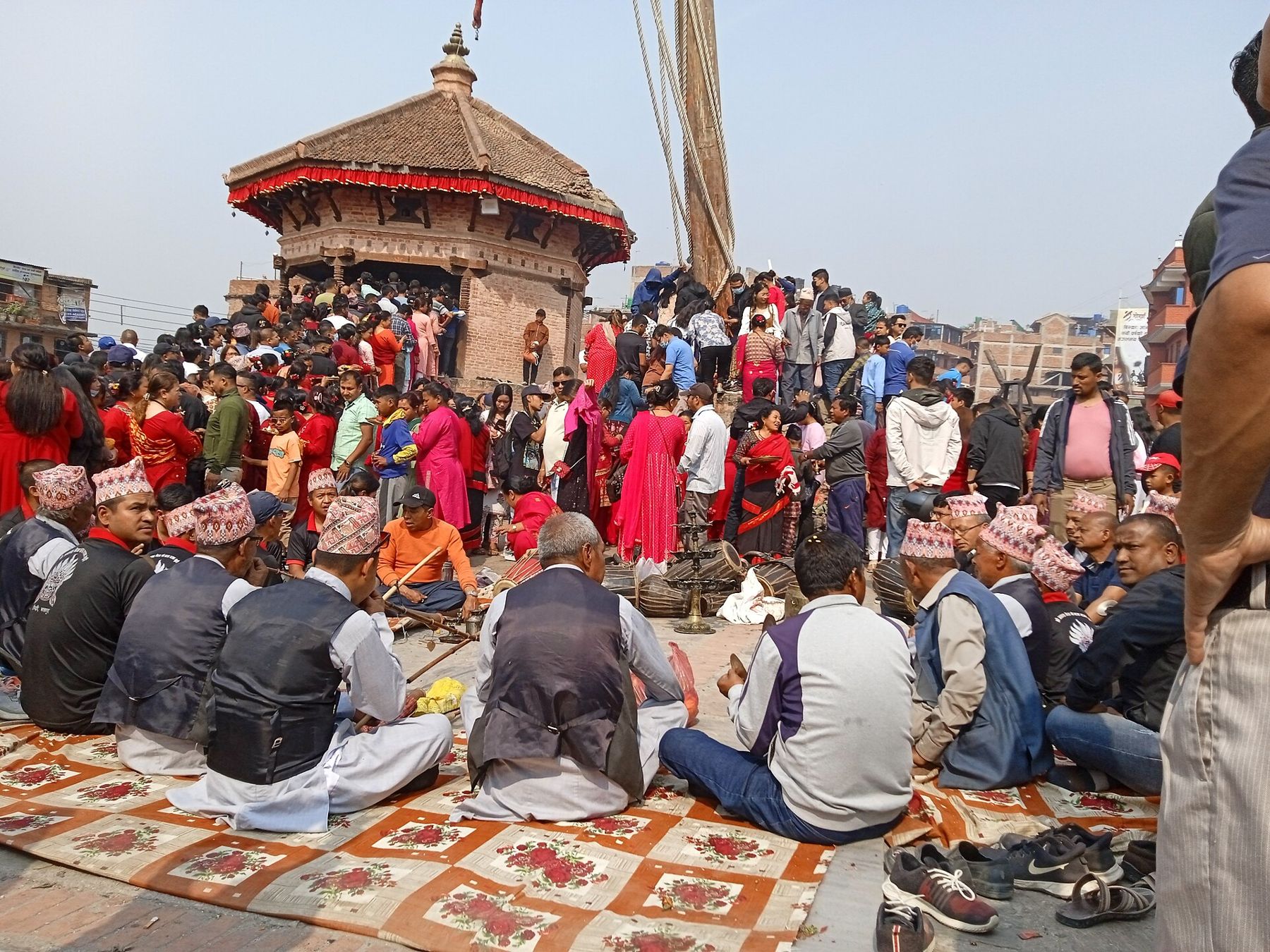
Bhaktapur, Khwopa in the Newar language, keeps its new year with more noise and muscle than anywhere else in the valley. Bisket Jatra, or Biska in Newar, runs for over a week around the first day of Baisakh, the start of the year in the Bikram Sambat calendar used across Nepal, which falls in mid-April. The dates follow the lunar and solar calendar together.
The festival belongs to the town rather than to any one temple, but its centre is Taumadhi Square, where the five-roofed Nyatapola rises above the three-roofed temple of Bhairab, the fierce form of Shiva who is the town's great protector. The guide to Bhaktapur covers the square on ordinary days. During Bisket it becomes a stage, a grandstand and a battlefield at once.
The chariot of Bhairab
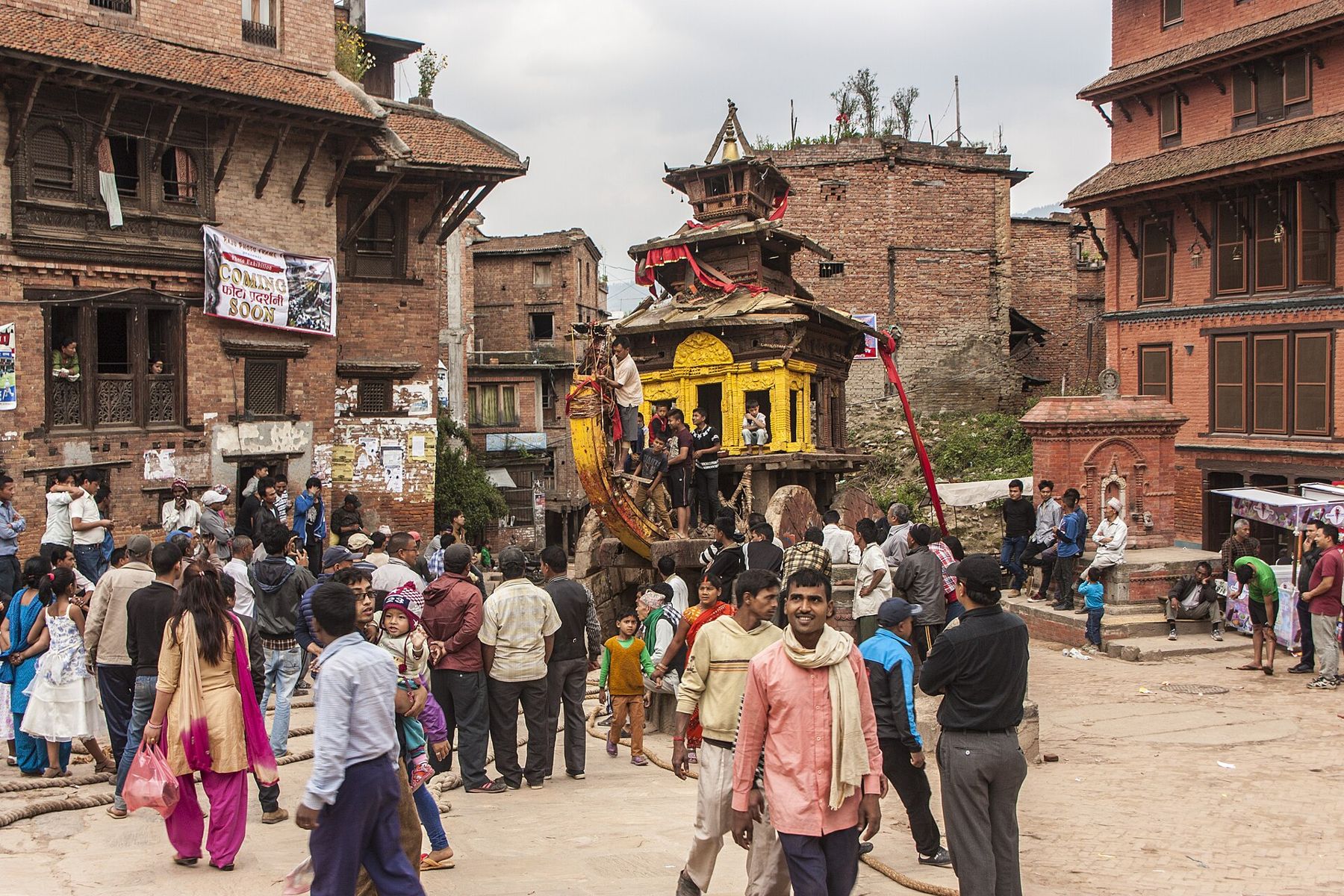
In the days before the festival, a huge wooden chariot is assembled in Taumadhi. It rolls on solid wooden wheels taller than a person, and on its platform stands a small temple with a tiered roof, hung with cloth and brass. The image of Bhairab is carried down from his temple and placed inside, and a smaller chariot is prepared for Bhadrakali, the goddess regarded as his consort.
The chariot has no steering in any modern sense. It is moved by long, thick ropes fixed to its front and back, and by the weight of hundreds of men hauling on them. Wooden beams are jammed under the wheels as brakes, and men ride on the platform and the beams, shouting to the pullers below.
The tug of war
The most famous moment comes when the chariot is pulled at Taumadhi. Bhaktapur has long been divided into an upper town and a lower town, Thane and Kone, and the two halves seize opposite ends of the ropes. Each side tries to drag the chariot into its own quarter. The side that wins is said to enjoy good fortune for the year, and the contest is hard fought.
The struggle can last for hours. The chariot lurches one way, stops, tilts on the uneven paving and lurches back. When it finally moves off, it heads down the sloping lanes towards the lower part of town, where it stays for some days before the return.
This is a real contest of strength, and it carries real risk. Wheels, ropes and surging crowds have caused injuries in past years. Watch from a raised step, a rooftop or a building with a view, keep well away from the wheels and the line of the ropes, and move when local people move.
Also in the valleyIndra Jatra, the festival of the living goddessThe lingo pole and the new year
The second great act of the festival takes place at a site called Yosinkhel on the edge of the town. There a tall wooden pole, the lingo or yosin, is raised with ropes and hung with two long banners. In local legend the banners recall two serpents that once troubled the town. The pole stands through the last night of the old year.
On the following day, the first of the new year, the pole is pulled down. Its fall marks the turning of the year, and crowds gather on the slopes and walls to watch. A pole of the same name and kind is raised in Kathmandu for Indra Jatra, the city's great autumn festival, which gives a sense of how widely the custom runs through Newar towns.
Music, processions and the villages around
Bisket is more than the two big moments. Through the week, groups of musicians with drums, cymbals and wind instruments play in the squares, and households carry offerings to local shrines. Gods are taken out on palanquins and carried through their quarters. Families invite relatives to feasts, and the town's food comes out in force, from beaten rice and spiced meat to sweets and curd. The guide to Newar food describes the dishes you are likely to meet.
The new year is also kept in the towns nearby. In Thimi, between Kathmandu and Bhaktapur, the day is known for processions of palanquins and clouds of orange vermilion powder thrown over the crowd. Neighbouring villages have their own customs at the same season. If you have more than a day, it is worth asking where something is happening, but expect each town to keep its own ways rather than perform for visitors.
Watching with care
A few simple habits help. Arrive early for the chariot pulling, as the best places fill long before anything starts. Keep your bag small and your hands free. Do not climb onto the chariot or its beams, and do not walk between the pullers. When a procession passes, step aside and let it go.
Photography is generally accepted in the open squares, but the festival is worship before it is spectacle. Ask before photographing people close up, and leave offerings and shrines untouched. Some rites take place in temples or courtyards where outsiders are not expected; if a doorway is guarded or a gesture tells you to stay back, accept it.
Bhaktapur's heritage area charges foreign visitors an entry fee, and festival days are no exception. Rooms in the old town fill up for the festival, and many visitors find that staying the night is the best way to see the early rites and the quieter evenings, when the squares belong to the town again.
A festival older than the kingdom
Bisket Jatra was already old when Bhaktapur was the capital of a Malla kingdom, one of the three that shared the valley until the 1760s. It survived the conquest by Prithvi Narayan Shah in 1769, the long Shah period and the end of the monarchy, and it carries on today largely in the hands of the town's own families and guilds. The rope, the chariot and the falling pole are still the town's business. For a visitor, the best way to honour that is to watch closely, stay out of the way and come back another year.